LVP vs. Laminate Flooring: Which Is Better for Your Home?
October 22, 2026
Luxury vinyl plank (LVP) and laminate flooring can look remarkably similar. Both offer realistic wood designs, durable surfaces, and a wide range of colors and textures. Both can also be installed using click-lock systems that connect the planks without individually gluing or nailing them to the subfloor.
But underneath those wood-look surfaces, they're different materials. Those differences influence water resistance, scratches, comfort, noise, installation, and performance in Colorado's unusually sunny, dry climate.
This article compares click-lock LVP with click-lock laminate flooring. Both are commonly installed as floating floors. Glue-down vinyl and other installation methods are outside the scope of this comparison.
LVP is often a versatile choice, particularly where moisture resistance matters. Modern laminate, however, deserves serious consideration. Improvements in waterproofing, surface durability, and appearance have made it much more competitive than older laminate products.
The better choice depends on the particular products, the room, and how the floor will be used.
LVP vs. Laminate: The Main Differences
The most important difference is what the planks are made of.
What Is Click-Lock LVP?
Luxury vinyl plank is constructed primarily from synthetic materials. Many modern click-lock products have a rigid composite core, commonly classified as SPC (stone plastic composite) or WPC (wood plastic composite).
A decorative layer creates the wood appearance, and a protective wear layer helps resist everyday use.
Because the core does not depend on conventional wood fibers, it generally does not absorb water and swell the way traditional laminate can.
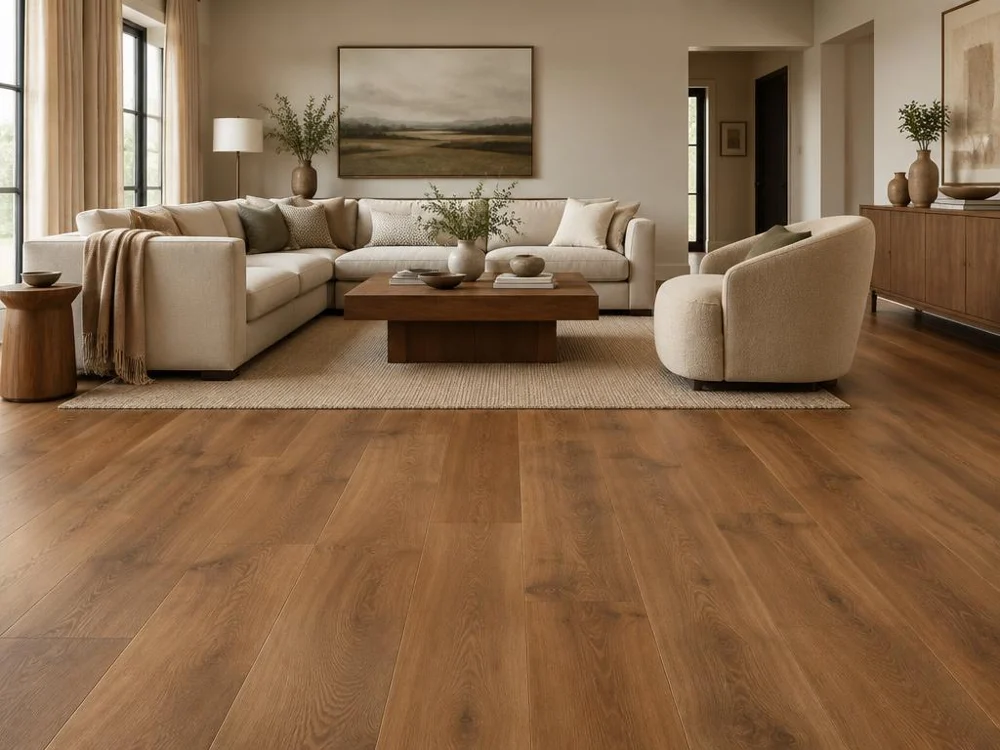
What Is Click-Lock Laminate?
Laminate typically uses a dense high-density fiberboard (HDF) core made from compressed wood fibers.
Above that core are a decorative image layer and a hard protective surface, often incorporating abrasion-resistant materials.
Laminate's surface can be exceptionally resistant to everyday wear and scratching. Its wood-based core, however, responds differently to moisture and humidity.
Modern laminate manufacturers have addressed many of those limitations with improved core materials, protective edge treatments, and more sophisticated locking systems.
Quick Comparison
| Feature | Click-Lock LVP | Click-Lock Laminate |
|---|---|---|
| Core material | Usually synthetic composite | Usually wood-fiber composite |
| Water resistance | Generally excellent | Varies; some modern products are designated waterproof |
| Core swelling from moisture | Generally resistant | Possible depending on construction and exposure |
| Scratch resistance | Good to excellent | Often excellent |
| Wood-look realism | Very realistic | Very realistic |
| Feel underfoot | Can feel slightly softer | Usually firmer |
| Footstep sound in the room | Often more muted | May sound sharper or more hollow |
| Sound transmitted downstairs | Depends on the complete assembly | Depends on the complete assembly |
| Straight plank cutting | Some products score and snap | Usually requires a saw or laminate cutter |
| Installation labor | Often less for easier-cut products | Can require more cutting and fitting time |
| Matching stair components | Collection-specific | Collection-specific |
| Direct sunlight performance | Product-specific heat and UV limits | Product-specific heat and UV limits |
| Low-humidity sensitivity | Generally less affected by humidity | Wood-fiber core responds to humidity |
| Best applications | Broad range, especially moisture-prone areas | Broad range, especially where surface abrasion resistance matters |
These are general tendencies, not guarantees. Individual products can perform quite differently.
1. Waterproof LVP vs. Waterproof Laminate
Water resistance used to be one of the clearest reasons to choose LVP over laminate.
Today, the comparison is more complicated.
Modern laminate manufacturers offer products with improved moisture-resistant cores, protective coatings, edge treatments, and locking joints designed to limit water penetration.
Some are expressly marketed as waterproof.
What Does Waterproof Laminate Really Mean?
A waterproof designation does not necessarily mean that every component of a laminate plank is impervious to water under every condition.
Manufacturers may define their claims around particular exposure conditions, installation requirements, or warranty limitations.
For example, Fashion Flooring carries Evoke Archways laminate, a collection designated waterproof by its manufacturer.
Other laminate collections may be described as water-resistant rather than waterproof. These descriptions should not be treated as interchangeable.
When evaluating waterproof laminate, the important questions are how long the product can tolerate standing water, whether the warranty covers surface spills, what happens if water enters from underneath, and which rooms the manufacturer approves.
A product may perform very well against routine kitchen spills without being suitable for flooding or persistent moisture.
Why LVP Still Has an Advantage
Most click-lock LVP products use cores that do not swell from water exposure in the same way conventional wood-fiber laminate cores can.
That gives LVP an inherent material advantage when water exposure is prolonged or unpredictable.
However, waterproof planks do not make an entire installed floor waterproof.
Water can still reach the subfloor, walls, cabinets, or surrounding materials. Both categories have installation requirements intended to manage moisture-related risks.
Can Waterproof Laminate Be Installed in Kitchens and Bathrooms?
Yes, when the specific manufacturer approves the application.
Modern waterproof laminate can be a suitable choice for kitchens and certain bathrooms. Some products carry restrictions on wet areas, sealing methods, or standing water.
LVP remains a practical starting point for moisture-prone spaces, but it would be inaccurate to dismiss all modern laminate as unsuitable.
2. Scratch Resistance and Everyday Durability
Laminate has a genuine strength in surface abrasion resistance.
Many laminate products use extremely hard protective surfaces designed to withstand everyday wear.
Laminate manufacturers sometimes publish an AC rating, an abrasion classification based on standardized testing.
For example, Fashion Flooring's Portercraft Bering Strait laminate lists an AC4 rating, while Evoke Archways lists AC5.
These ratings help describe laminate surface performance. They should not be compared directly with LVP wear-layer thicknesses, because they measure different characteristics.
LVP typically uses a transparent protective wear layer, sometimes described in mils, along with additional surface coatings.
A thicker wear layer can be desirable, but thickness alone does not determine scratch resistance.
Which Is Better for Dogs?
Both can perform well in homes with dogs.
High-quality laminate may offer excellent resistance to scratching from claws and tracked-in grit.
LVP offers a practical advantage around water bowls, wet paws, and pet accidents.
Neither is completely scratch-proof. Surface texture, finish, product quality, and routine cleaning matter.
3. Which Looks More Like Real Hardwood?
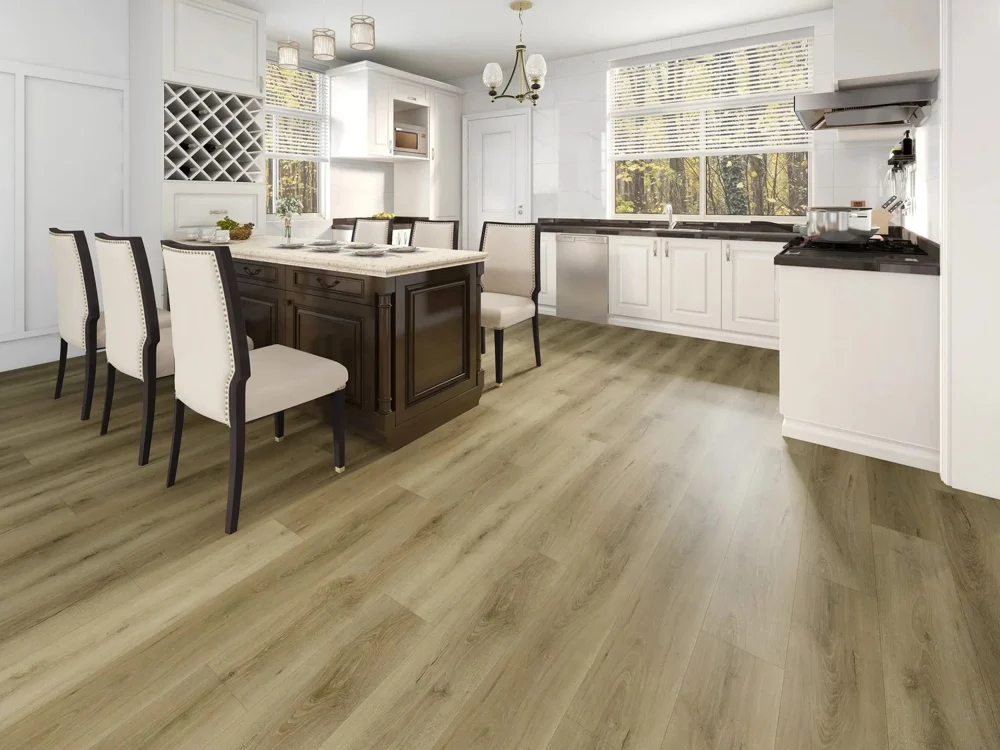
Both LVP and laminate can convincingly reproduce hardwood.
Modern products offer natural wood-grain patterns, low-gloss finishes, wide planks, embossed textures, and realistic color variation.
Some products use embossed-in-register technology, aligning surface texture with the printed grain.
Laminate's hard surface can create a convincing wood-like feel. Premium LVP can be equally attractive.
There is no reliable universal winner for appearance.
The most useful comparison is between actual samples viewed in the room's lighting, alongside cabinetry, paint colors, and adjacent flooring.
4. Which Is Quieter: LVP or Laminate?
Sound is one of the most misunderstood differences between these materials.
There are three separate questions: how loud footsteps sound within a room, how much impact noise travels to rooms below, and how much airborne sound passes through the floor-ceiling structure.
These are not the same thing.
Footstep Noise Within the Room
Laminate's hard surface can produce a sharper tapping sound from shoes, pet claws, or dropped objects.
Depending on the installation, it may also sound somewhat hollow.
LVP often produces a duller, more muted footstep sound. However, rigid-core LVP can also sound hard or hollow, particularly without effective acoustic backing.
A laminate product with an appropriate acoustic underlayment may sound quieter than an LVP product with less effective sound control.
LVP often sounds quieter within the room, but that does not automatically mean it transmits less sound downstairs.
Impact Sound Transmission Between Floors
In a two-story house, condominium, or apartment, footsteps and dropped objects can transmit vibrations through the floor into the room below.
This is called impact sound.
A common measurement is IIC — Impact Insulation Class. Higher ratings indicate better impact sound isolation under the relevant test conditions.
Some flooring systems also publish Delta IIC, which describes the improvement provided by a floor covering over a reference concrete slab.
These measurements require careful interpretation.
An IIC result from a concrete floor with a suspended ceiling cannot be directly compared with one from a different floor-ceiling assembly.
The tested construction matters enormously.
Neither LVP nor laminate is consistently superior at blocking impact sound across every installation.
Airborne Sound: Voices, Television, and Music
Airborne noise is different from impact noise.
Sound transmission from conversations, televisions, and music is commonly evaluated using STC — Sound Transmission Class.
Higher STC ratings indicate better airborne sound isolation for the tested assembly.
The floor-ceiling structure, insulation, and other building components generally matter much more than whether the visible surface is LVP or laminate.
Neither hard-surface material alone should be expected to soundproof a room.
Do Attached Acoustic Pads Help?
Yes, but their effectiveness varies.
Some click-lock LVP and laminate products include attached acoustic backing. Others require a separate approved underlayment.
For example, Portercraft Bering Strait lists a 2 mm attached pad.
An appropriate pad can help reduce certain footstep sounds and improve impact sound performance.
But thicker or softer padding is not automatically better.
Click-lock joints require adequate support. An incompatible underlayment can allow excessive movement and potentially damage the locking system.
For condominiums and multifamily properties, compare the building's acoustic requirements with test results for a suitable floor-ceiling assembly.
Which Feels Softer Underfoot?
LVP can feel slightly softer underfoot than laminate, although many rigid-core LVP products are quite firm.
Laminate generally feels harder because of its dense wood-based core and protective surface.
The difference can be subtle.
When Carpet Is the Better Acoustic Choice
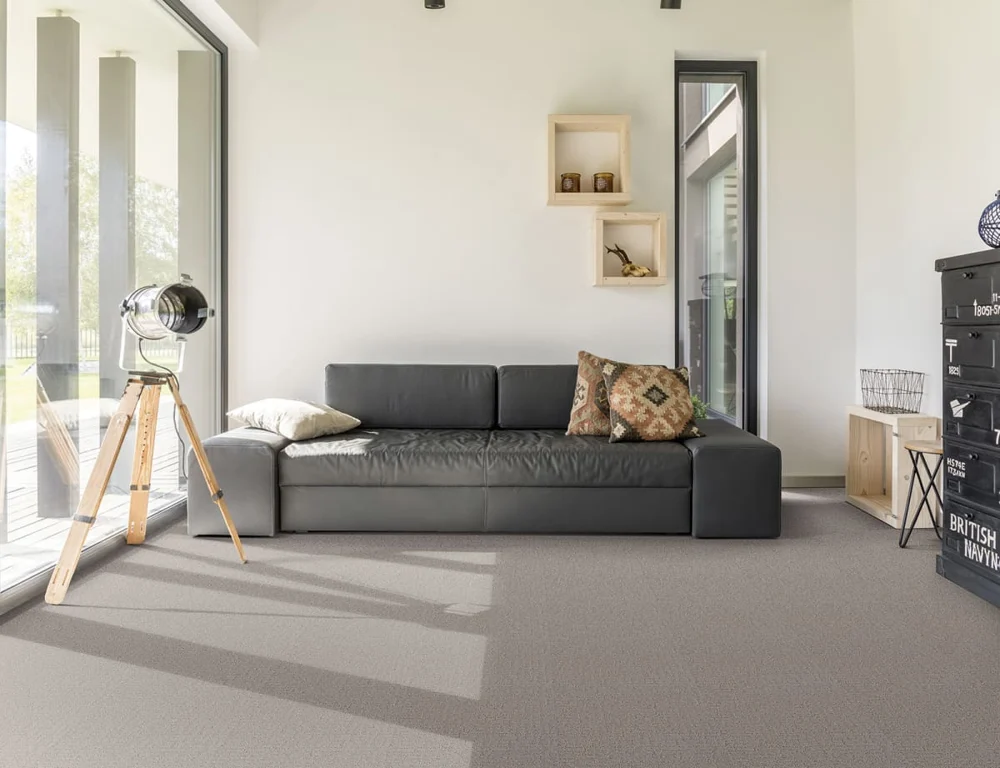
If reducing footstep noise is a major priority, carpet deserves consideration.
Carpet with appropriate padding generally provides much better footstep-noise reduction than either hard-surface category. It can also substantially reduce impact noise transmitted to rooms below.
That's one reason a home may use LVP or laminate in main living spaces and coordinating carpet in upstairs bedrooms, hallways, and on stairs.
5. Installation: Why Click-Lock Laminate Can Cost More to Install
Both click-lock LVP and laminate are commonly installed as floating floors.
The planks connect through mechanical locking joints, rather than being individually fastened to the subfloor.
Although the basic installation approach is similar, the materials can require different tools, cutting methods, and amounts of labor.
Cutting LVP
Many click-lock LVP products can be scored with a utility knife and snapped along a straight cut.
This can make installation faster and reduce the amount of saw cutting.
However, not every LVP product supports score-and-snap cutting. Some rigid-core constructions require saws or specialized cutters.
The manufacturer's instructions determine the appropriate method.
Fashion Flooring's click-lock LVP selections include Pinnacle Depth and Bastion Primo.
These are useful examples of click-lock LVP, although their specific cutting methods must be confirmed from installation documentation rather than assumed.
Cutting Laminate
Laminate typically requires a saw or a specialized laminate cutter.
Its dense wood-fiber core and hard protective surface make it less suitable for ordinary utility-knife scoring.
A manual laminate cutter can make straight cuts efficiently and without generating the same airborne dust as a saw.
However, detailed cuts around doorways, corners, vents, and other obstacles often require saw work.
Cutting laminate can create considerable fine dust, making appropriate dust collection and respiratory protection important.
Its hard surface can also be demanding on cutting blades.
Locking Systems
Both flooring categories use several locking-system designs, including angle-angle, angle-tap, and fold-down mechanisms.
Some require planks to be angled into place. Others allow particular edges to fold or lock down.
The ease of installation depends on the specific locking system.
Laminate may require careful angling and tapping to connect the joints without damaging the edges.
Some LVP locking systems can also be delicate and require precise alignment.
Neither category should be forced together contrary to the manufacturer's instructions.
Why Installation Labor Can Differ
Laminate may require additional cutting time, dust management, careful fitting, and joint assembly.
These factors can increase labor costs.
Click-lock LVP products that can be scored and snapped may install more quickly, particularly in straightforward rooms.
But this is not universal. A complicated LVP installation can take longer than a simple laminate installation.
For an accurate comparison, consider the total installed cost, not just the material price per square foot.
6. Which Flooring Is Better for Colorado Homes?
Colorado's climate creates challenges that generic national flooring comparisons often overlook.
High-altitude sunshine, low indoor humidity, substantial seasonal temperature changes, and snow tracked indoors can all affect flooring performance.
These considerations are particularly important in homes with large south- or west-facing windows.
High-Altitude Sunshine: UV Exposure and Heat
Colorado's elevation means sunlight travels through less atmosphere before reaching the ground.
Two separate effects matter for flooring: ultraviolet exposure and solar heat buildup.
UV exposure can gradually change the color of flooring materials. Both LVP and laminate can fade or discolor, although resistance varies by product and protective coating.
Solar heating is a different issue.
Sunlight entering through large windows can raise the floor's surface temperature well above the room's air temperature.
Some rigid-core LVP products have strict surface-temperature limits. Excessive heat can contribute to expansion, distortion, buckling, or joint problems.
Laminate can also experience dimensional changes and other problems from excessive heat or changing environmental conditions.
Neither category should automatically be considered suitable for unlimited direct sunlight.
For sunny Colorado rooms, check the manufacturer's specifications for maximum floor-surface temperature, direct-sunlight restrictions, UV resistance, expansion requirements, and warranty exclusions.
Window coverings and solar-control glass can help reduce excessive heating.
In a room with intense direct sunlight, the specific product's heat tolerance may matter more than whether it is LVP or laminate.
A particular laminate product may be a better choice than a particular LVP product in a highly sun-exposed room, depending on verified specifications.
Colorado's Dry Climate and Low Humidity
Colorado's dry climate creates another challenge, particularly in winter when indoor heating can further reduce relative humidity.
Laminate generally contains a wood-fiber core that responds to changes in moisture and humidity.
As indoor air becomes very dry, the material may contract. When humidity rises, it may expand.
Excessive changes can contribute to gaps, movement, or other dimensional problems.
LVP's synthetic core generally responds less to humidity changes than conventional wood-fiber laminate.
That can be an advantage in Colorado.
However, LVP is not immune to environmental conditions. Temperature changes can still cause expansion or contraction.
Both materials should be used within the manufacturer's specified indoor temperature and humidity ranges.
Snow, Wet Boots, and Entryways
Colorado may be dry overall, but entryways and mudrooms can experience substantial moisture from melting snow.
LVP is often practical in these areas because its core is generally less susceptible to water-related swelling.
Modern waterproof laminate may also be appropriate when the specific product is approved for the application.
Colorado Basements
Basements can have different moisture and temperature conditions from the main level of a home.
LVP is frequently selected because of its moisture-resistant construction.
Some laminate products are also approved for below-grade use.
Neither should be installed without satisfying the manufacturer's moisture and environmental requirements.
The Colorado Takeaway
For low indoor humidity, wet entryways, and changing seasonal conditions, LVP is often a practical starting point.
But rooms with intense direct sunlight require special attention. Some LVP products have strict heat-exposure limitations, and an appropriately rated laminate may be preferable.
A floor that performs beautifully in a shaded bedroom may not be the best choice for a south-facing living room with floor-to-ceiling windows.
7. What About Stairs?
Both LVP and laminate can be used on stairs when the manufacturer approves the product and installation method.
The important issue is whether suitable matching stair components are available.
Stair Noses
A stair nose provides the finished front edge of a step.
Depending on the product, it may sit flush with the flooring or overlap the surface.
Matching stair noses are available for some LVP and laminate collections.
Full Stair Treads and Caps
Some manufacturers offer full stair treads or stair caps that incorporate the finished front edge.
These can create a more continuous appearance than separate planks and nosing.
Full-tread systems are available for selected products in both categories, but should not be assumed available for every collection.
Matching Risers and Trim
Before choosing flooring for a staircase, verify the availability of the necessary noses, treads, risers, and transitions.
Also confirm that the proposed stair installation is manufacturer-approved and meets applicable safety and building requirements.
Carpeted Stairs
Carpet is another practical option.
It provides a softer walking surface and generally reduces footstep noise compared with hard-surface flooring.
Coordinating carpeted stairs can work well with wood-look LVP or laminate on adjoining floors.
8. Room-by-Room Recommendations
| Room or application | What to consider |
|---|---|
| Kitchen | LVP is often preferred for moisture resistance; approved waterproof laminate can also work |
| Bathroom | Check specific product approval and wet-area installation requirements |
| Entryway or mudroom | LVP's core construction offers a practical advantage with wet shoes and snow |
| Living room | Either can work well; compare appearance, durability, comfort, and sunlight exposure |
| Bedroom | Either hard surface can work; carpet may be preferable for softness and quiet |
| Upstairs hallway | Consider acoustic performance and carpet alternatives |
| Basement | LVP is often favored; some laminate products are approved below grade |
| Rental property | Compare durability, replacement availability, moisture resistance, and total cost |
| Home with dogs | LVP offers moisture advantages; high-quality laminate may offer excellent abrasion resistance |
| Sun-filled room | Compare actual UV, heat, and temperature specifications before choosing |
9. How Do Costs Compare?
Both LVP and laminate are available at a wide range of prices.
Some laminate products cost less than comparable LVP. Premium laminate can also cost as much as or more than certain vinyl products.
Installation labor may differ because of cutting requirements, locking systems, and room complexity.
Additional costs can include removal of existing flooring, transitions, trim, underlayment, and stair accessories.
The most useful comparison is between specific products at their total installed prices.
10. Which Should You Choose?
For many homes, click-lock LVP is an excellent starting point.
Its moisture-resistant core, wide selection of styles, and potentially simpler installation make it versatile.
Modern laminate is a serious alternative, especially when scratch and abrasion resistance are priorities.
The main considerations are straightforward:
- Water exposure: LVP generally has an inherent core-material advantage, but modern waterproof laminate can also be suitable.
- Scratches: High-quality laminate can offer excellent abrasion resistance.
- Appearance: Both can convincingly reproduce hardwood.
- Footstep sound: LVP often sounds more muted, but the product and underlayment matter.
- Sound transmission: Compare tested floor assemblies, not material categories.
- Installation: Some click-lock LVP products are easier to cut and install.
- Colorado sunshine: Verify actual heat and UV restrictions.
- Low humidity: LVP generally responds less to humidity changes than wood-fiber laminate.
- Stairs: Check matching accessory availability.
- Overall value: Compare the total installed cost.
Neither material is universally better.
Frequently Asked Questions
Is click-lock LVP easier to install than laminate?
Often, but not always. Many click-lock LVP products can be scored and snapped, while laminate generally requires a saw or specialized cutter. Locking-system design and room layout also affect installation difficulty.
Is waterproof laminate really waterproof?
Some manufacturers designate specific laminate collections as waterproof. The meaning and limitations of that claim depend on the product, installation requirements, and warranty. It should not be interpreted as protection against every type of water exposure.
Can laminate be installed in kitchens?
Yes. Many modern laminate products are suitable for kitchens, including manufacturer-approved waterproof collections.
Which is more scratch-resistant?
Some laminate products have exceptionally abrasion-resistant surfaces and may outperform certain LVP products. Performance varies by product.
Is LVP quieter than laminate?
LVP often produces a more muted footstep sound within a room. However, sound transmitted to rooms below depends on the complete floor-ceiling assembly.
Does an attached pad make flooring soundproof?
No. Attached pads can improve certain acoustic characteristics, but they do not make a floor soundproof.
Can click-lock LVP be installed on stairs?
Yes, when the product and stair-installation system are approved for that application. Matching stair noses or full treads are not available for every collection.
Which is better for homes with dogs?
Both can work well. LVP offers useful moisture resistance, while some laminate products provide excellent surface abrasion resistance.
Which is better for a basement?
LVP is often preferred because of its core construction. Some laminate products are also approved for below-grade installation, subject to manufacturer requirements.
Can direct Colorado sunlight damage LVP or laminate flooring?
Yes. UV exposure can affect color, while excessive solar heating can create dimensional or joint problems. Check the specific product's sunlight, temperature, and warranty requirements.
Does Colorado's low humidity affect laminate flooring?
It can. Laminate's wood-fiber core responds to humidity changes. Very dry indoor conditions may contribute to contraction or movement outside the manufacturer's specified environmental range.
Is laminate installation more expensive than LVP?
It can be. Laminate often requires more saw cutting and detailed fitting, which may increase labor time. Actual costs depend on the products and installation.
Explore Your Options
Compare click-lock LVP, modern laminate, and coordinating carpet in Fashion Flooring's Louisville showroom, or request an estimate for your project.
Fashion Flooring — COLORADO'S FASTEST FLOORS
303-586-5300 | fashionflooring.com
Call for a Free Estimate